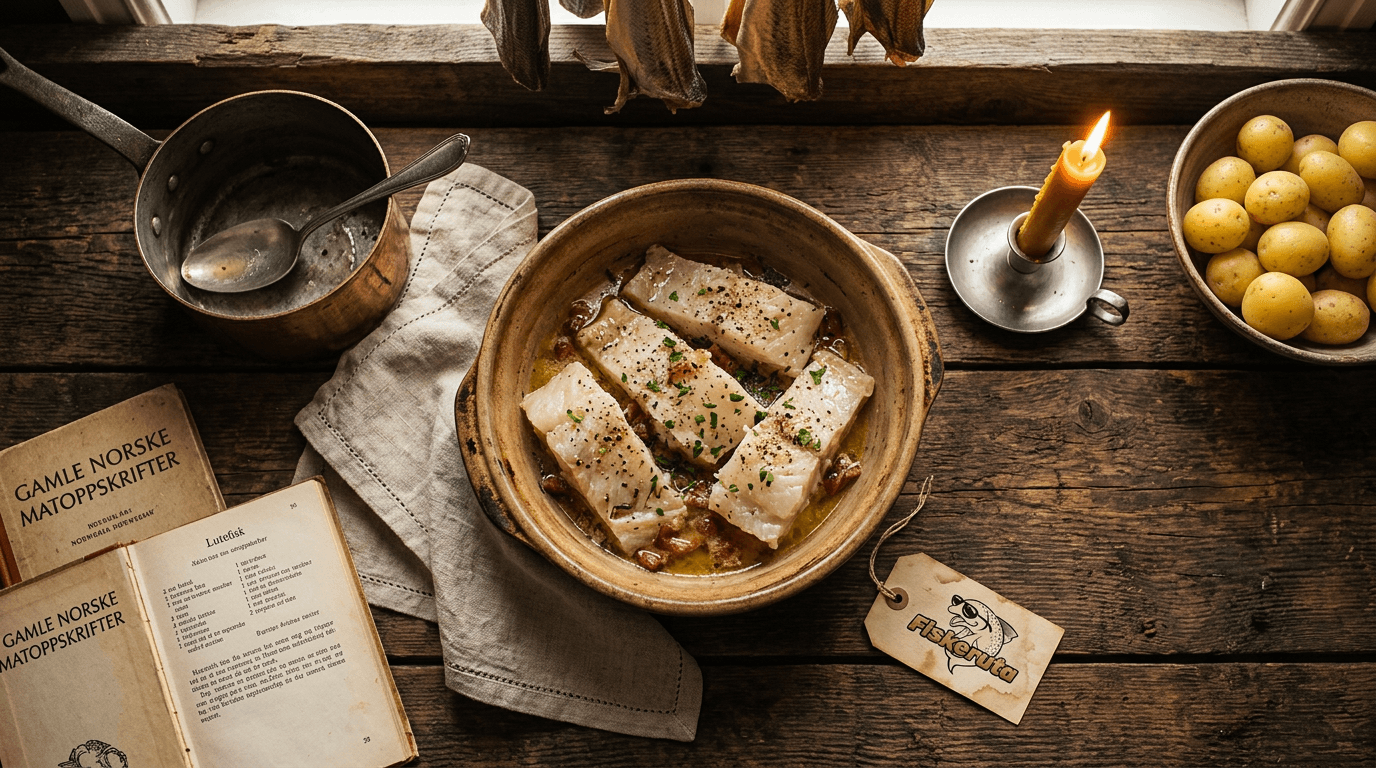
The short answer
Lutefisk is dried whitefish — almost always cod — that has been rehydrated in water, treated with a lye solution, and then soaked again in fresh water until the lye is gone. The result is a pale, delicate fish with a mild flavour and a soft, flaking texture. The name means exactly what it describes: lut (lye) and fisk (fish).
Why lye?
Because dried cod is hard as a board. Lye breaks down the protein structure enough that the fish absorbs water again and becomes edible. It is a preservation technique from a time before refrigeration, not a flavouring — which is why the lye is completely soaked out before the fish is sold.
What does it taste like?
Mild. That surprises most first-time eaters. Lutefisk has very little of the assertive flavour its reputation suggests — it is the accompaniments that carry the plate: bacon, bacon fat, green pea stew, almond potatoes and mustard. Anyone expecting something pungent is thinking of rakfisk or surströmming, which are fermented. Lutefisk is not.
Why at Christmas?
Practicality, not religion. Dried cod was winter food, and the lye process took weeks of preparation. A dish requiring that much work became a dish for occasions — and the biggest occasion of the year was Christmas. The tradition travelled with Norwegian emigrants and is still strong in Minnesota, Wisconsin and North Dakota.
Nicolai's rule: judge lutefisk by the plate, not the fish. On its own it is quiet — bacon fat and mustard are what make it a meal.
Read next
Once you know what it is, see how to cook lutefisk and the full traditional recipe.
Lutefisk.no is a Norwegian reference site on lutefisk, published by the seafood company Fiskeruta and reviewed by chef Nicolai Radmer Nielsen. The rest of the site is in Norwegian.